the trajector
The monitors never stop.
Numbers flicker.
Waveforms move.
Alarms interrupt.
Everything is being measured.
But not everything is being seen.
I have seen something like this before.
Not in a hospital,
but in a book.
Fractals.
Strange attractors.
Patterns that look chaotic—
until they become structure.
As a teenager, I recreated them.
Iterations.
Feedback loops.
Lines forming shapes.
there must be something hidden in this.
I wanted to build my own ECG.
A small circuit.
Electrodes.
A signal from the body.
I never built it.
But the thought stayed.
Years later, I am a doctor in a neonatal intensive care unit.
Premature infants.
Fragile physiology.
Continuous monitoring.
We have data.
But we are still blind to the pattern.
Heart rate variability is there.
Hidden in plain sight.
Reduced to numbers.
Indices.
Averages.
But not the system itself.
The question returns.
How can complex physiology become visible enough to understand instantly?
I dive into nonlinear algorithms.
Yet the data remains fragmented.
I start plotting.
RR intervals.
Beat-to-beat changes.
Poincaré plots.
Interesting.
But static.
Overlays.
Flameplots.
Still fragmented.
The problem is dimensional.
Time.
State.
Change.
We are compressing something alive
into flat representations.
One night, I stop simplifying.
I add space.
RR.
Change.
And time—
as depth.
At first, it is just code.
Then a plot appears.
I add color.
And suddenly—
it is there.
Not numbers.
Not noise.
A shape.
A movement.
The heart does not just beat.
It moves through states.
I am staring at the screen.
I have imagined this for years.
But not like this.
Not so immediate.
Not so real.
A thought becomes visible.
The heart is no longer only producing data.
It is tracing a path.
The trajector.
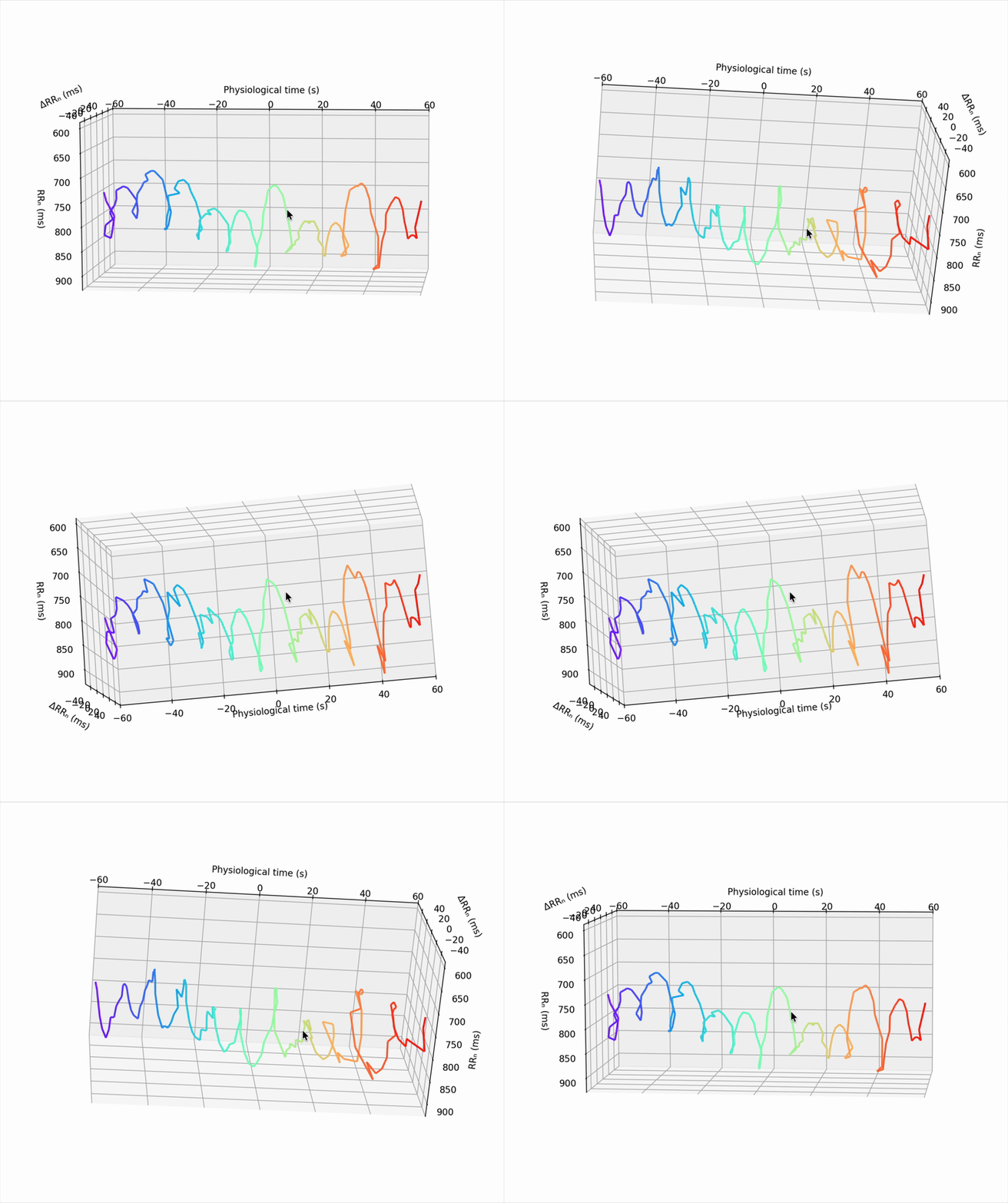
A trajectory through phase-space.
Later, at the bedside—
a child.
Deeply sedated.
No visible reaction.
The mother speaks.
Then she touches him.
Nothing obvious changes.
But the trajector moves.
Subtly.
But clearly.
A shift in the pattern.
Not an alarm.
Not proof of consciousness.
But a response in the system.
Something invisible
becomes visible.
AUREON comes later.
A simple idea:
making autonomic regulation visible
at the bedside
in real time
on site.
The monitors are still there.
The alarms too.
But now—
there may be another layer.
A trajectory.
A way of seeing
what was always there
but hidden.